
https://indd.adobe.com/view/24cd68c0-6960-4f79-87bb-25c0080757d8
Essay on the NZDC first 10 years, June 2022. NZDC
Essay on the NZDC first 10 years, June 2022.
https://indd.adobe.com/view/24cd68c0-6960-4f79-87bb-25c0080757d8
Becoming an Aucklander
Forty years ago, in January 1986, I arrived in Auckland. I’d come from the cold, short days of New York City, to an Auckland of glass-bottled milk delivery trucks, scented night flowers and hot beaches. I’d left my one bedroom, mouse and cockroach- infested apartment in Brooklyn to begin a new life with my love, who at that time lived in a converted garage behind a large, Sandringham house. The streets were flat, the lawns large and I had no idea how to become an Aucklander. I was 28.
Don and I married on 1st January 1989 at the Michael Joseph Savage Memorial on Bastion Point. It rained, but we could still get glimpses of Rangitoto through the mist. Afterwards we had homemade sandwiches and champange at our flat in Parnell with his family. A week later we threw a party for our friends at the Grey Lynn Library Hall. BYO. Lynda Topp was our MC. My life in Auckland was beginning to take shape, externally and internally.
By then I had been dancing as a member of Limbs Dance Company as well choreographing and performing as a freelancer in self-produced concerts and with others. I’d joined Limbs in 1987, following the departure of founding member Mary Jane O’Reilly. Now led by Cath Cardiff, and with me as rehearsal director, the company soon became a grounding environment, allowing me a way into New Zealand society and culture but via a language that I knew well, dance. I had been a dancer since a young child, entering the profession in New York in my early twenties, and through my work with Limbs I could be myself while also adapting to the unfamiliar customs during a typical day of classes and rehearsals; afternoon tea, going to the dairy for a snack or the local pub for a beer after work. A cheese sandwich on Vogels Bread, a chocolate fish, a DB beer at the Gluepot, all of these contributed to my acclimatization. The studio on Brown Street in pre-gentrified Ponsonby provided a window onto the people of many cultures who called Auckland home. After a six-month sojourn in Sydney to work with another dance company in 1988, I returned to Auckland.
A few days after Don and I had our not-a-wedding reception party in early January 1989, I flew to Wellington to commence work with Douglas Wright and his newly-launched dance company. I first worked with Douglas when he arrived back in New Zealand in 1987 from his four years in New York and I danced in his work Quartet on Limbs’ tenth annniversary tour. Then in early 1988 I was a member of his ground-breaking, controversial work, Now is the Hour, the only time I appeared in a dance that was picketed by protestors outside a theatre (it was in Tauranga and was organised by the ‘concerned citizens group’. Definitely not Auckland behaviour). In Wellington he and I shared an apartment on Brougham St in Mt Victoria and Don came down to visit occasionally. Rehearsals for the premiere work of this company, How On Earth, took place in the abandoned Erskine College in Island Bay. But my time in Wellington was limited and while I would have teaching stints from time to time at the New Zealand School of Dance / Te Whaea in Newtown over the years, I always returned to Auckand.
We bought an old villa in Eden Terrace though at the time there was some confusion as to whether we lived in Kingsland or Eden Terrace. I always maintained it was Eden Terrace, the Dominion Road end. The post code was 1021. One had to step lightly through the overgrown, empty lot next door to our house to avoid recently deposited used condoms. Our no-exit street was, apparently, close enough to the red light district of Karangahape Road to provide a safe parking spot. Also, the large house at the end of the street had recently been converted from a sauna to a flats. Needless to say, thirty-seven years later the street has long lost its reputation as being in the ‘rough’ side of town. Our first cat is buried out front of our house, though none of our family still live there.
I can’t recall the precise moment or who came up with the idea or how it even came about, but early in 1989 a group of friends in Auckland came together to discuss opening up and running our own theatre. At this point Don and Harry had been successfully touring their Front Lawn shows, Mike and Marie had produced several Inside/Out Theatre productions, Jennifer and Michael were Theatre Corporate stalwarts, Shona, Felicity and I were making dance works under the moniker ‘Merchants of Venus’, Lynda was performing with her sister as the Topp Twins, Bruce appeared frequently with both Inside/Out and Mercury Theatre productions, Caroline, another Theatre Corporate member, was Harry’s partner, and Miranda, even though a Wellingtonian through and through, was working frequently in Auckland both on stage and in televison on that most Auckland of shows, Gloss. This melange of thespians, musicians and dancers were joined by Margi, a publicist and (briefly) Nick, an experienced actor and arts administrator.
The end of the eighties saw a big shift in the performing arts scene in Auckland. Up until this time Wellington had been referred to as the ‘cultural capital’ of New Zealand and there had been longstanding rivalry and competition for funding and recognition of quality between the two cities. But in 1989 Limbs Dance Company folded and the Mercury Theatre was waning. On the other side groups like Inside/Out and The Front Lawn were drawing in new audiences who were perhaps experiencing live performance for the first time. The Performing Arts School opened, filling a gap in theatre and dance classes as a result of the demise of both Theatre Corporate and Limbs. There was a buzz in town accompanied by a feeling of enormous potential to make meaningful and relevant performing arts in Auckland. Plus, we were all friends, many of us were couples, and spent alot of time together, either being in each others’s shows or going to each other’s shows. Of course this was all well before the Silo, the Basement and Q Theatre, whose origins stemmed from our experience.
We held our first meeting at Harry and Caroline’s house in Herne Bay in April 1989 and produced a fairly bland and limited manifesto, as stated in the minutes from the meeting: ‘Our aim is to create a great Auckland venue which we control and will suit our needs.’ In contrast, our weekly meetings over the years were anything but bland and I think, in spite of the serious and committed work we set out for ourselves, we all found that the social bonds and friendships were strengthed by our shared goal. Reflecting and finding inspiration in other historical groups of artists who came together for a shared vision, such as the Workers Drama in NYC in the 1930s, the surrealists and existentialists of the 1940s, the Christchurch Art Society in the 1950s, the Living Theatre group in the 1960s, we combined fun and excess with our passion for producing meaningful, relevant, playful, serious, outrageous performing art. The centruifugual force of our shared excitement and zeal in our own individual art forms kept us together and (mostly) focused.
Throughout our first year of meetings we bandied about many names for our venture, some serious, others less so: Auckland City Theatre, the Jetty Group, the Play Group, Big Fish, the Wall of Blood Group, etc. However, we soon agreed that what we wanted was a venue on the then neglected Auckland waterfront. This was before any semblence of a nightlife existed on the Viaduct. The only businesses in the area had to do with boats, boat equipment, boat storage and fisheries. An America’s Cup victory for Team New Zealand was still a far off dream and any potential development of the land and buildings in the Viaduct was earmaked for that glorious, hoped-for event. Dollar signs loomed large in front of the eyes of the mayor and council, alternative and original theatre and dance not so much. The people of Auckland did not venture past Victoria Park after dark. But we could see the potential in bringing crowds to a theatre in a part of town that many people had never been to. By mid-1990 we had agreed on The Watershed as the name and set about making a theatre on the waterfront.
It was also an especially fecund time personally for us all; by 1990 Mike and Marie had two children, Bruce and Felicity three, Don and I had produced our first child in 1991, the same year that the inaugural Watershed venue opened on Hobson Wharf. With meetings held at each other’s homes, we often held babies, our own or each other’s, during the meetings. I recall the highlight of each meeting, after the conclusion of all the formal business items, being the gossipy talk we all looked forward to, coming prepared with contributions that we hoped might shock or just surprise even the most jaded among us. Being the true theatre profesionals that we were there was plenty of bitchy nuggets. As well as reveling in each other’s successes we delighted at other’s downfalls. And there always seemed to be plenty of both to share. Fundamentally, we believed that Wellington’s time was over and Auckland would soon be the city where performing arts flourished and grew. We would make it happen.
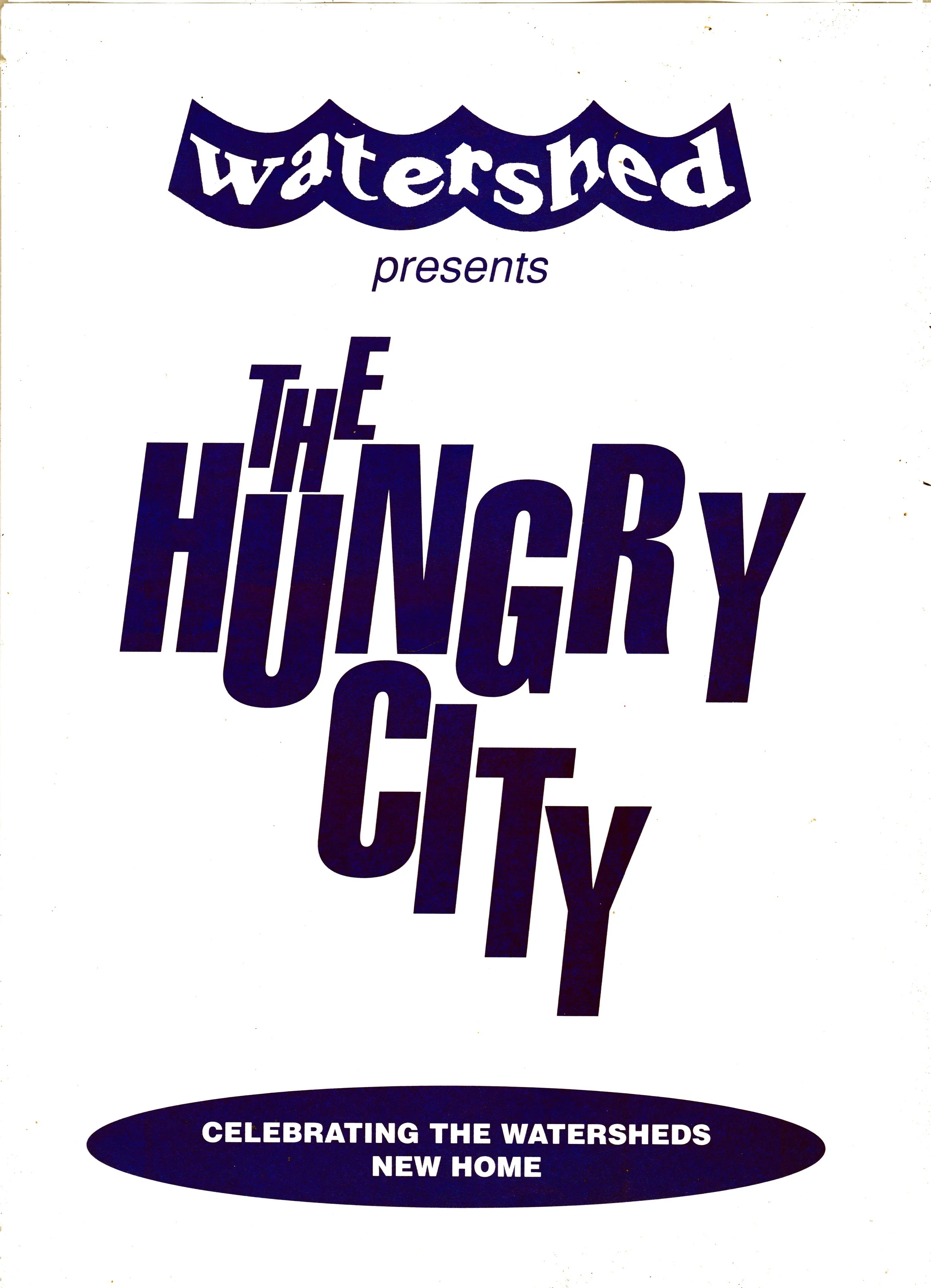
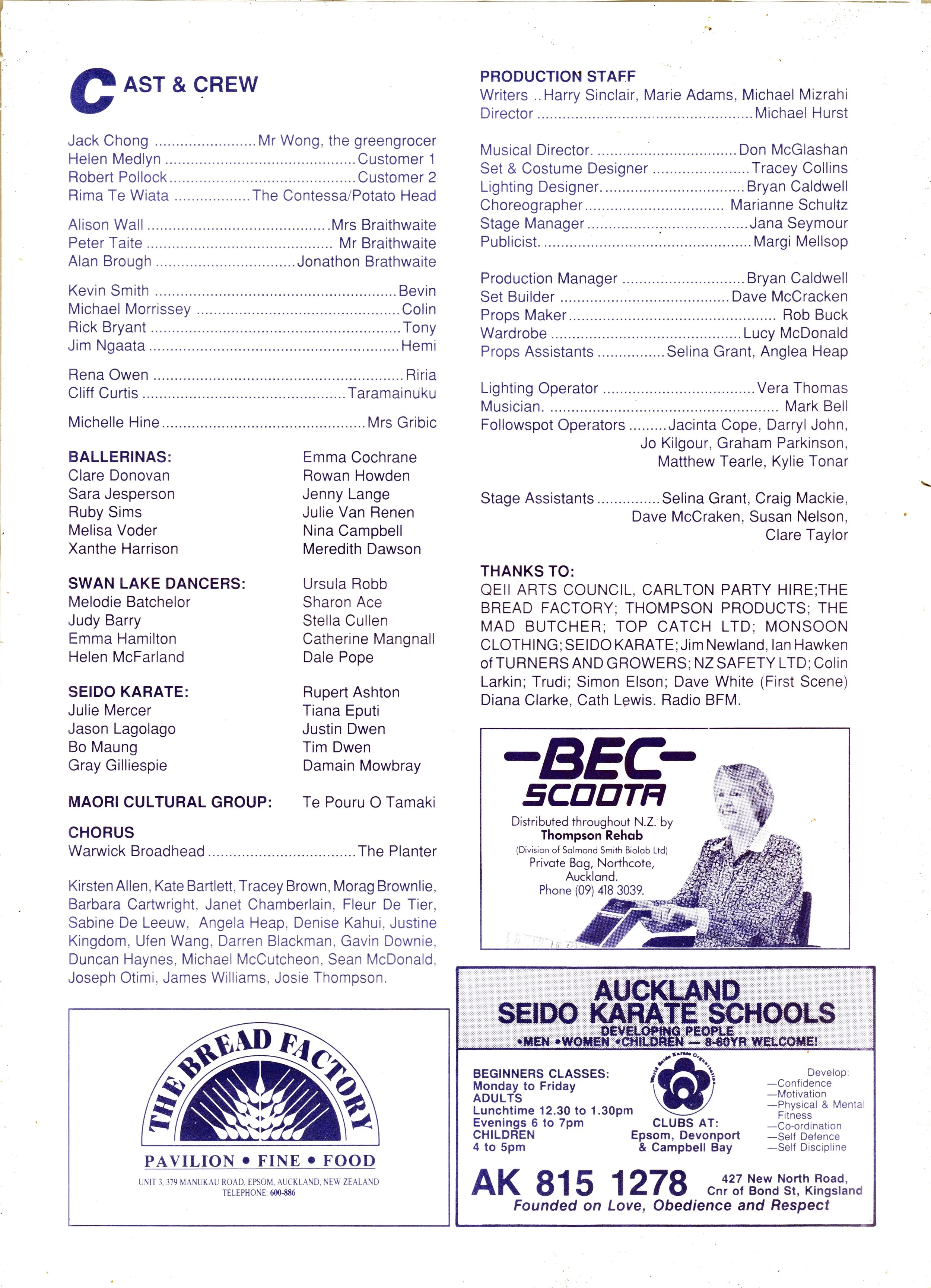
And we did for awhile. The Hobson Wharf venue hosted its inaugural three-month festival of theatre, music and dance in the winter of 1991. Shows included the first ever double bill of the Front Lawn and Topp Twins, a new Inside/Out Theatre production, The Song of the Civilised Thief , set in mud and involving a lot of wood chopping, and a children’s show by The Aunties, A Porpoise with a Purpose. Our opening show in the second, more permanent Watershed venue on Customs Street West in mid-1992 was titled The Hungry City. Converting the upstairs of a Turners and Growers warehouse, putting the final touches on the soon-to-be-infamous bar moments before the doors opened, The Hungry City was a collaborative effort from us all (Don wrote the songs, Mike, Marie and Harry wrote the script, Michael directed, with choreography by me).
Auckland was at the centre of the somewhat convoluted story of The Hungry City; the disapperance of fruit and vegetables in the city due to a carnivorous young boy whose appetite caused farmers to abandon growing vegetables in favour of more profitable meat production (the character’s costume, designed by Tracey Collins, provided one of the most memorable, darkly humerous moments, of the production. Think self carnivorous behaviour). Songs such as Turn and Grow and The Last Potato in the World, referenced the building’s history. Cliff Curtis and Rena Owen played a couple who resided in the attic of the building and, speaking in te reo Māori, argued about who was the better gutarist, Jimmy Hendrix or Eric Clapton, while also providing an alternative explanation for the disappearance of the vegetables.
I directed a chorus of dancers through a march across Auckland, vocally externalising their path as they traversed the space, as envisaged by Harry, Mike and Marie:
…Once you get to College Hill look right;“Bacon, Smallgoods, Poultry, Pork Cuts”. Look right; “Fresh Cut Flowers”. Straight across to Wood Street by the Morton Bay Fig, right onto Pember Reeves...Along Calliope Road, on the way to the Devonport Ferry, past the fire station and the Hilltop Dairy...Left into Mt Eden Road, W.H. Tongue and Sons Limited, Astrology House, the Power Station, and the green steepled church, Through the lights at Boston Road you’ll see Mt Eden behind Midas Mufflers Brakes Shocks…
The rousing chorus of the song Owed to Auckland,written by Don and sung by Rima Te Wiata, summed up strong feelings we all had at the time of the place we called home. In an era of stock markets crashing and unemployment and rents rising, we still believed that Auckland was a place where we could thrive. To a tune that a kick line of jazz-hands dancing women would be proud, Rima sang:
I wanna talk and
it’s Auckland
I wanna talk about.
Auckland is more lovely than it seems
How the old volcanoes roll
Round the town that has no soul
But the suburbs bloom with every human dream...
I wanna talk and
it’s Auckland
I wanna talk about
‘Cause Auckland City is my home town
While I’ve have periods away from Auckland – the four years in London in the mid- 1990s during the Mutton Birds adventure, and two and a half years back in New York in the late-2010s after my marriage ended – there is nowhere else that I want to live. My two children were born here, at the National Women’s Hospital overlooking Cornwall Park. My closest friends are here. I’ve studied te reo Māori for free, a privilege that I most grateful.
My work as a historian of dance and performing arts is enriched by being here. I’ve danced and taught in many venues and studios across Auckland, most, sadly, now gone: the Orange Ballroom in Eden Terrace (now apartments), the Masonic Hall on Upper Queen Street (now apartments), the glorious, purpose built dance studies at the Unitec Mt Albert campus (demolished for apartments), the Old Folks Association in Newton (not apartments, thank god), the Maidment Theatre at University of Auckland, (a hole in the ground), His Majesty’s Theatre (a carpark), the St James Theatre (tbc). The Customs Street West site of the Watershed is also now apartments.
Although I rarely spend time on a beach and don’t own a barbeque, my feet are happy to touch the ground whenever I pass through Customs easily at Auckland Airport, my heart is stilled by the song of the Tui in a nearby tree, or on a cold, clear mid-year night, marvelling at the arrival of Matariki. After forty years Tāmaki Makaurau Auckland is well and truly my home town. I am an Aucklander.
copyright Marianne Schultz 2026
